


A business can have good sales, regular customers, and a healthy looking profit but still struggle to understand where its money actually stands.
Why?
Because when a business earns money and when it actually receives that money aren't always the same thing.
For example, imagine you sell ₹1 lakh worth of products to a customer on credit in March. The customer agrees to pay you in April.
You made the sale in March.
But the money hasn't reached your bank account yet.
So, when you look at your business finances, should that ₹1 lakh be considered March income or April income?
This is where cash accounting and accrual accounting come into the picture.
Understanding the difference is important for growing businesses because the accounting method you use can affect how you view revenue, expenses, profit, receivables, and overall financial performance.
What Is Cash Accounting?
Cash accounting records income and expenses when money is actually received or paid.
In simple terms:
Money comes in → record income.
Money goes out → record expense.
Example
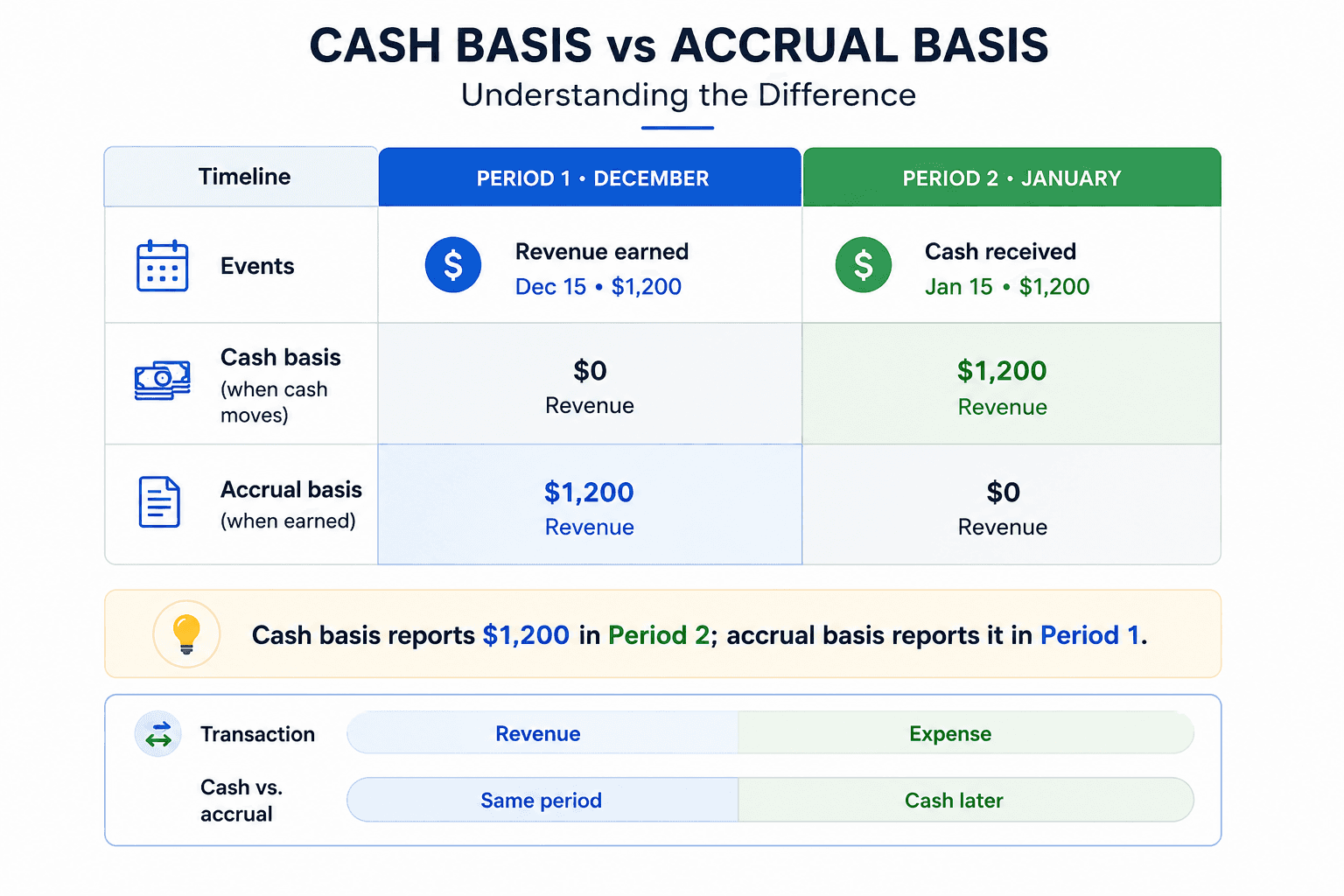
Suppose you sell goods worth ₹50,000 on credit in March.
The customer pays you in April.
Under cash accounting:
March → No ₹50,000 income is recorded yet
April → ₹50,000 is recorded when payment is received
The focus is on actual cash movement.
What Is Accrual Accounting?
Accrual accounting records income and expenses when they are earned or incurred, rather than waiting for the actual cash movement.
Using the same example:
You sell goods worth ₹50,000 in March and expect payment in April.
Under accrual accounting:
March → ₹50,000 revenue is recognized
April → Payment is received and the receivable is settled
So, accrual accounting focuses more on when the business activity happens, not just when the money moves.
Cash Accounting | Accrual Accounting |
|---|---|
Records income when cash is received | Records income when it is earned |
Records expenses when payment is made | Records expenses when they are incurred |
Focuses on cash movement | Focuses on overall financial activity |
Easier to understand | Provides a broader financial picture |
Can be simpler for smaller operations | Often more useful as businesses become complex |
Credit sales may be reflected later | Credit sales are recognized when earned |
Less visibility into outstanding receivables/payables | Better visibility into receivables/payables |
The important point is that neither method is simply “good” or “bad.”
The right approach depends on the nature, size, complexity, and accounting requirements of your business.
Why Does This Difference Matter to a Growing Business?
When a business is small, its financial activity may be relatively straightforward.
You sell something.
You receive payment.
You pay your expenses.
But as the business grows, things become more complicated.
You may start offering:
Credit sales
Customer payment terms
Supplier credit
Recurring expenses
Multiple branches
Large inventory
Purchase orders
Outstanding invoices
Advance payments
Different payment cycles
Now, cash movement alone may not tell the complete story.
For example:
Your business could make ₹10 lakh worth of sales this month but collect only ₹7 lakh.
If you look only at cash received, you might think sales were ₹7 lakh. But your actual sales activity was ₹10 lakh, with ₹3 lakh still outstanding. This distinction becomes increasingly important as a business scales.
A Simple Example: Why Cash and Profit Can Look Different
Let's understand this with a simple example.
Imagine a business makes the following transactions in April:
Credit sales: ₹2,00,000
Cash sales: ₹1,00,000
Expenses incurred: ₹1,20,000
Customer payments received: ₹1,50,000
Under an accrual approach, revenue is recognized based on the sales earned, while expenses are recognized when incurred.
Under a cash approach, the focus is on what was actually received and paid during April.
This can produce very different looking numbers.
That's why business owners should understand the difference between:
Sales ≠ Cash received ≠ Profit
These three numbers can be very different.
Cash Accounting: Advantages and Limitations
Advantages
Simple to Understand
It focuses on actual cash received and paid, making the records relatively straightforward.
Easier Cash Visibility
You can quickly see how much money has actually moved through the business.
Less Complex for Certain Small Businesses
Businesses with mostly immediate payments and simple operations may find cash-based tracking easier to understand.
Limitations
Doesn't Show the Complete Financial Picture
Outstanding customer payments may not appear as revenue until cash is received.
Can Make Business Performance Look Different
A month with delayed customer payments could appear weaker even if sales were strong.
Limited Visibility Into Future Cash Obligations
Expenses that have been incurred but not yet paid may not be reflected in the same way.
Accrual Accounting: Advantages and Limitations
Advantages
Gives a Better Picture of Business Performance
Revenue and expenses are matched more closely to the period in which they occur.
Better Visibility Into Receivables
You can identify money customers owe you.
Better Visibility Into Payables
You can understand obligations owed to suppliers and other parties.
Useful for Growing Businesses
As transactions become more complex, accrual accounting can provide a more complete picture of financial activity.
Limitations
More Complex
It requires proper tracking of receivables, payables, accrued expenses, and other accounting items.
Profit Doesn't Equal Cash
A business can report revenue and profit while still waiting for customers to pay.
Requires Better Record-Keeping
Businesses need accurate and timely bookkeeping to maintain reliable accrual records.
Which Businesses May Benefit From Cash Accounting?
Cash based accounting can be easier to manage when a business:
Has relatively simple transactions
Receives most payments immediately
Has limited credit sales
Has fewer outstanding invoices
Doesn't have complex financial arrangements
Primarily needs straightforward cash tracking
However, businesses should consider applicable accounting and tax requirements before choosing or changing an accounting method.
Which Businesses May Need a More Detailed Accrual View?
As businesses grow, they often need better visibility into transactions that don't happen at the same time as cash movement.
This can include businesses with:
Significant credit sales
Multiple customers with payment terms
Supplier credit
Large inventories
Multiple branches
Longer operating cycles
Significant outstanding receivables
Significant outstanding payables
For these businesses, understanding what has been earned, what is owed, and what has actually been paid can be critical for decision-making.
Cash vs Accrual: Which One Is Better for Growing Businesses?
There isn't one universal answer.
The better question is:
Which method gives your business the information it needs while meeting the applicable accounting and compliance requirements?
For a very small business with simple cash transactions, cash-based tracking may be easier to understand.
But as a business starts dealing with credit sales, outstanding payments, supplier dues, inventory, multiple locations, and more complex transactions, an accrual view can become increasingly valuable.
And even businesses that primarily think in terms of cash need to monitor receivables, payables, and cash flow carefully.
Don't Confuse Accrual Accounting With Cash Flow Management
This is one of the most important points for business owners.
Accrual accounting tells you about business performance.
Cash flow tells you about actual cash availability.
A business can be profitable but have cash flow problems.
For example:
You make ₹10 lakh in sales. But customers have paid only ₹6 lakh. Your business may have earned revenue, but you only have ₹6 lakh of that revenue in cash so far. At the same time, your suppliers may expect payment.
This is why growing businesses should monitor both:
Profitability + Cash Flow
You need to know not only:
How much did I earn?
but also:
How much cash do I have available?
How Receivables and Payables Change the Picture
As a business grows, two numbers become particularly important:
Accounts Receivable
Money that customers owe your business.
Example:
You sell ₹2 lakh of products on credit. Until the customer pays, that ₹2 lakh is an amount receivable from the customer.
Accounts Payable
Money your business owes to suppliers or other parties.
Example:
You purchase inventory worth ₹1 lakh on credit. Until you pay the supplier, that amount becomes payable.
Tracking both helps business owners understand the difference between business activity and actual cash movement.
What Should Growing Businesses Track?
Regardless of the accounting method, business owners should regularly monitor:
Revenue
How much did the business sell?
Expenses
How much did the business spend?
Receivables
How much money do customers still owe?
Payables
How much does the business owe suppliers?
Cash & Bank Balance
How much money is actually available?
Inventory
How much money is tied up in stock?
Profitability
After considering relevant costs and expenses, how much is the business actually earning?
Looking at these numbers together gives a much better understanding of the business than looking at sales alone.
How HisabKitab Helps Businesses Maintain Better Financial Visibility
Choosing an accounting method is only one part of the process.
The bigger challenge is maintaining accurate, organized, and updated financial records.
This is where accounting software can help.
HisabKitab brings accounting and business management together, helping businesses manage their financial transactions while keeping important business information organized.
With HisabKitab, businesses can manage:
Sales and purchase transactions
Customer receivables
Supplier payables
Expenses
Inventory
GST-related records
Bank transactions
Business reports
Multi-location operations
Instead of maintaining information across multiple spreadsheets, businesses can keep important financial and operational information connected.
For example:
A credit sale doesn't just represent a sale.
It can also affect:
Sales → Customer Receivable → Inventory → Accounting → Cash Collection
When these pieces are connected, business owners can better understand what is happening financially.
Before vs After: Managing Business Accounts
Before
A growing business may use:
Billing Software + Excel + Separate Accounting + Manual Reports
The owner may have to:
Export sales
Update spreadsheets
Check customer dues
Record expenses
Reconcile transactions
Prepare reports
This can consume significant time.
After
With connected accounting software:
Sales + Purchases + Inventory + Receivables + Payables + Reports
can be managed in a more organized system.
The result?
Less repetitive work → better visibility → easier monitoring → smarter decisions.
7 Tips for Growing Businesses to Improve Accounting
Don't Track Only Sales
Sales are important, but they don't tell you everything. Track revenue, expenses, receivables, payables, cash, inventory, and profitability.
Monitor Customer Dues Regularly
A sale isn't the same as money in the bank. Keep track of outstanding invoices and payment timelines.
Keep Supplier Payments Organized
Knowing what you owe and when it is due helps prevent cash flow surprises.
Reconcile Bank Transactions Regularly
Compare your accounting records with actual bank transactions to identify discrepancies.
Separate Business and Personal Transactions
Keeping business finances separate makes accounting and financial analysis much easier.
Review Reports Monthly
Don't wait until the end of the financial year to understand how your business is performing.
Use Accounting Software as Your Business Grows
As transactions increase, automation can help reduce repetitive data entry and improve financial visibility.
A Quick Decision Checklist
Before deciding which accounting approach is suitable, ask:
Does my business sell mostly for cash or on credit?
Do I have significant customer receivables?
Do I purchase inventory on credit?
Do I have multiple branches?
Are my transactions becoming more complex?
Do I need to understand profitability by period?
Do I need detailed financial reporting?
What accounting and tax rules apply to my business?
The answers can help you and your accountant determine the most appropriate approach.
Important: Accounting and tax treatment can depend on the business structure, applicable laws, and regulatory requirements. Businesses should consult a qualified accountant or tax professional when deciding which accounting method to adopt.
let connect today book your free demo now!
Continue Reading