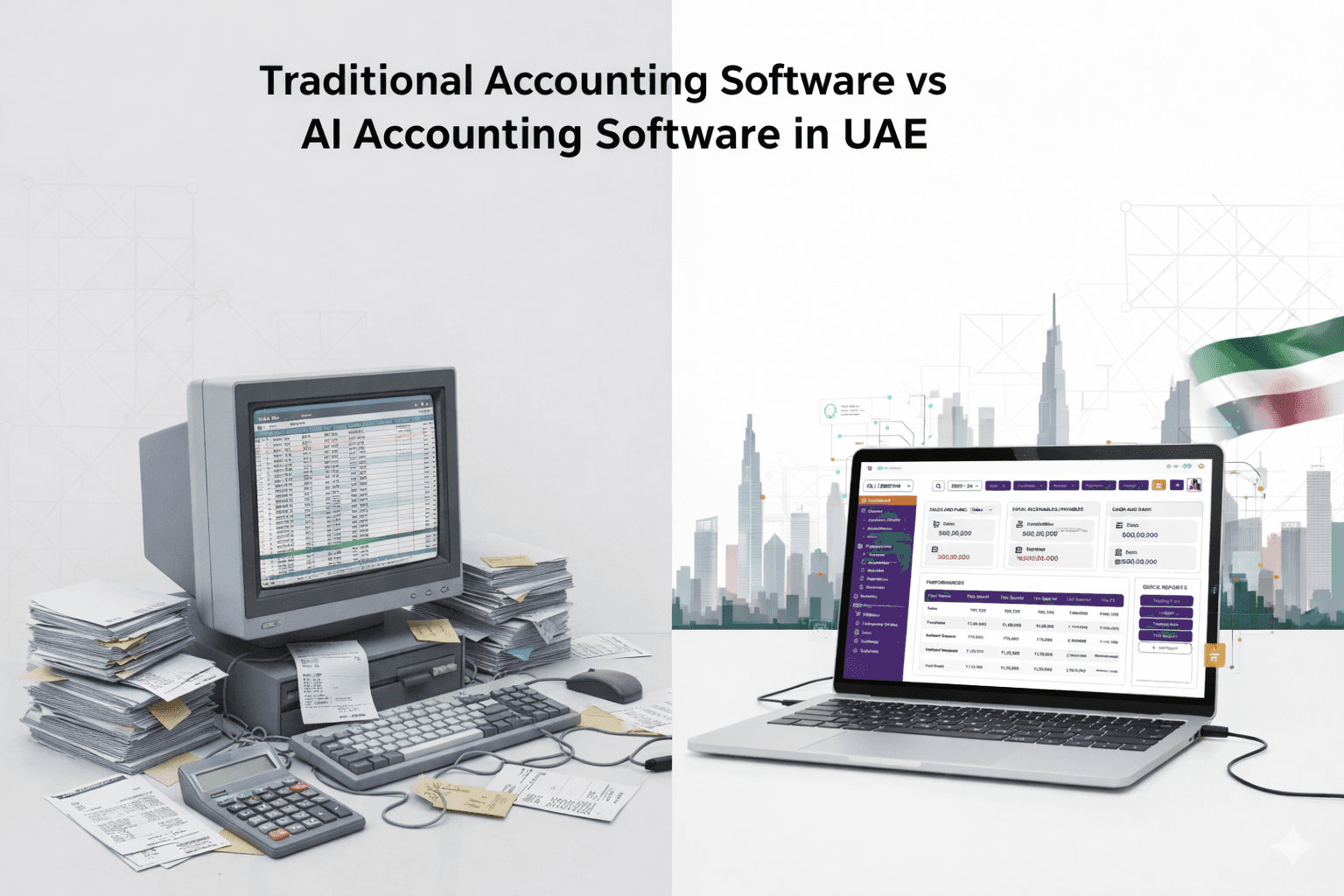


Accounting in the UAE has changed significantly over the last few years. What once worked with desktop software and manual data entry is now struggling to keep up with VAT compliance, high transaction volumes, multi-currency operations, and real-time reporting needs.
In 2026, UAE businesses are increasingly comparing traditional accounting software with AI-powered accounting software to decide what best supports growth and compliance. This blog explains the real differences between the two and why many businesses are moving toward AI-driven systems like hisabkitab.
What Is Traditional Accounting Software?
Traditional accounting software typically refers to desktop or basic cloud tools that rely heavily on manual data entry. These systems usually require accountants or staff to enter:
Sales invoices
Purchase bills
Expense vouchers
Journal entries
Bank transactions
While traditional software can maintain basic books, it depends largely on human input and periodic updates.
Limitations of Traditional Accounting Software in UAE
For modern UAE businesses, traditional systems often create challenges:
Manual data entry increases the risk of errors, especially with VAT calculations. Month-end accounting becomes stressful because data is not updated in real time. Business owners have limited visibility into cashflow, outstanding payments, or tax liabilities until reports are prepared.
Traditional software also struggles with:
Multi-currency transactions
Real-time VAT tracking
Remote access for teams
High invoice volumes
Faster compliance requirements
As businesses grow, these limitations become more visible.
What Is AI Accounting Software?
AI accounting software uses artificial intelligence and automation to handle repetitive accounting tasks automatically. Instead of relying fully on manual entry, AI systems can:
Read invoices and bills automatically
Categorise transactions intelligently
Suggest correct ledgers
Reduce manual corrections
Keep books updated continuously
AI accounting does not replace accountants it reduces manual work and improves accuracy.
How AI Accounting Software Fits UAE Business Needs
In the UAE, businesses deal with VAT, audits, multi-currency transactions, and frequent reporting. AI accounting software is designed to support these requirements by keeping records clean and updated at all times.
With AI-powered systems, VAT is calculated accurately, bills are recorded faster, and financial data is available in real time. This allows business owners to make decisions without waiting for month-end reports.
Traditional vs AI Accounting: Key Differences in Practice
With traditional software, accounting happens after the transaction data is entered later, reconciled later, and reviewed later. With AI accounting, records are updated as transactions happen.
Traditional systems depend heavily on skilled manpower and repeated checks. AI accounting reduces dependency on manual effort and improves consistency.
For UAE businesses, this difference directly affects compliance, speed, and financial control.
Why UAE Businesses Are Shifting Toward AI Accounting
In 2026, UAE businesses are under pressure to be faster, more compliant, and more data-driven. AI accounting software helps by:
Reducing manual entry work
Improving VAT accuracy
Providing real-time financial visibility
Supporting remote and multi-location teams
Handling high transaction volumes efficiently
This shift is especially visible among SMEs, trading companies, retailers, and service businesses.
How hisabkitab Brings AI Accounting to UAE Businesses
hisabkitab is a cloud-based accounting platform with AI-driven automation, designed for modern UAE businesses.
It helps businesses by automatically reading purchase bills and expenses, suggesting correct ledgers, and keeping books updated in real time. VAT-ready invoicing, multi-currency support, and cloud access make it suitable for UAE compliance and operations.
Instead of spending hours on data entry, businesses using hisabkitab spend more time analysing numbers and planning growth.
Which One Is Better for UAE Businesses in 2026?
Traditional accounting software may still work for very small setups with low transaction volumes. However, for most UAE businesses dealing with VAT, multiple payments, suppliers, and customers, AI accounting software offers a clear advantage.
AI accounting is faster, more accurate, and better aligned with modern business requirements in the UAE.
Conclusion
The choice between traditional accounting software and AI accounting software is no longer just about preference it’s about efficiency, compliance, and future readiness.
In 2026, UAE businesses that want real-time visibility, reduced manual work, and better control over their finances are increasingly choosing AI-powered solutions. Platforms like hisabkitab represent this shift by combining automation, accuracy, and simplicity in one system.
Ready to Experience AI Accounting in the UAE?
If you want to reduce manual accounting work, improve VAT accuracy, and gain real-time financial clarity:
Book a free demo of hisabkitab today and see how AI accounting works for modern UAE businesses.
Continue Reading