

Introduction: Why Cost Accounting Matters More Than Ever
In today’s competitive business world—where margins are thin, customers demand better pricing, and efficiency decides survival—cost accounting is no longer optional.
It is the backbone of decision-making for manufacturing units, traders, agencies, startups, and service companies.
Yet many Indian businesses still struggle with:
scattered cost data
manual calculations
untracked expenses
guess-based pricing
no visibility into profit per product/project
This is exactly where cost accounting and modern cloud tools like hisabkitab make a massive difference.
What Is Cost Accounting?
Cost accounting is a system of recording, analyzing, and controlling all costs related to production, operations, and services.
Its goal is simple: help businesses understand the true cost of what they produce or sell.
Compared to normal accounting (which focuses on compliance), cost accounting focuses on decision-making.
Why Do Businesses Use Cost Accounting?
Cost accounting helps you:
✔️ Identify your real cost per product or project
✔️ Set the right selling price
✔️ Avoid losses by spotting excessive expenses
✔️ Improve efficiency of employees, machines & processes
✔️ Decide what to scale—and what to discontinue
✔️ Estimate profitability before entering new markets
It gives founders and finance teams the actual picture behind profits, not just the financial statements.
Types of Costs in Cost Accounting
To understand cost accounting properly, you must know the cost components:
1. Direct Costs
Costs directly related to production:
Raw materials
Direct labour
Consumables
2. Indirect Costs
These are overheads that support the business:
Rent
Utilities
Salaries
Depreciation
3. Fixed Costs
Do not change with output:
Factory rent
Equipment lease
4. Variable Costs
Increase as production increases:
Materials
Packaging
Delivery charges
5. Semi-Variable Costs
Fixed + variable combined:
Electricity
Maintenance
Cost accounting groups these to calculate accurate costing.
Methods of Cost Accounting
Different industries use different methods:
1. Standard Costing
Predetermined costs used to measure performance.
2. Marginal Costing
Cost is calculated per additional unit produced.
3. Activity-Based Costing (ABC)
Costs are allocated based on activities like processing, packing, shipping, etc.
4. Job Costing
Used in projects, construction, agencies, and CAs.
5. Process Costing
Used by manufacturers—textile, chemicals, FMCG, etc.
6. Batch Costing
Used for bakeries, pharma, food production, packaging.
How Cost Accounting Helps in Pricing
One of the biggest benefits:
You know exactly how much it costs to make or deliver something.
So you can set selling prices confidently and avoid losses.
Example:
If your real product cost is ₹220 but you're selling for ₹200, cost accounting exposes it immediately.
Common Problems Indian Businesses Face Without Cost Accounting
❌ Wrong pricing
❌ Confusion in profit per product
❌ High wastage / leakage
❌ Stock mismatch
❌ Overspending on labour or materials
❌ No clarity on which product/service is profitable
Cost accounting fixes every one of these.
Where hisabkitab Comes In: Cost Accounting Made Simple
Traditional cost accounting is:
manual
time-consuming
spreadsheet heavy
prone to errors
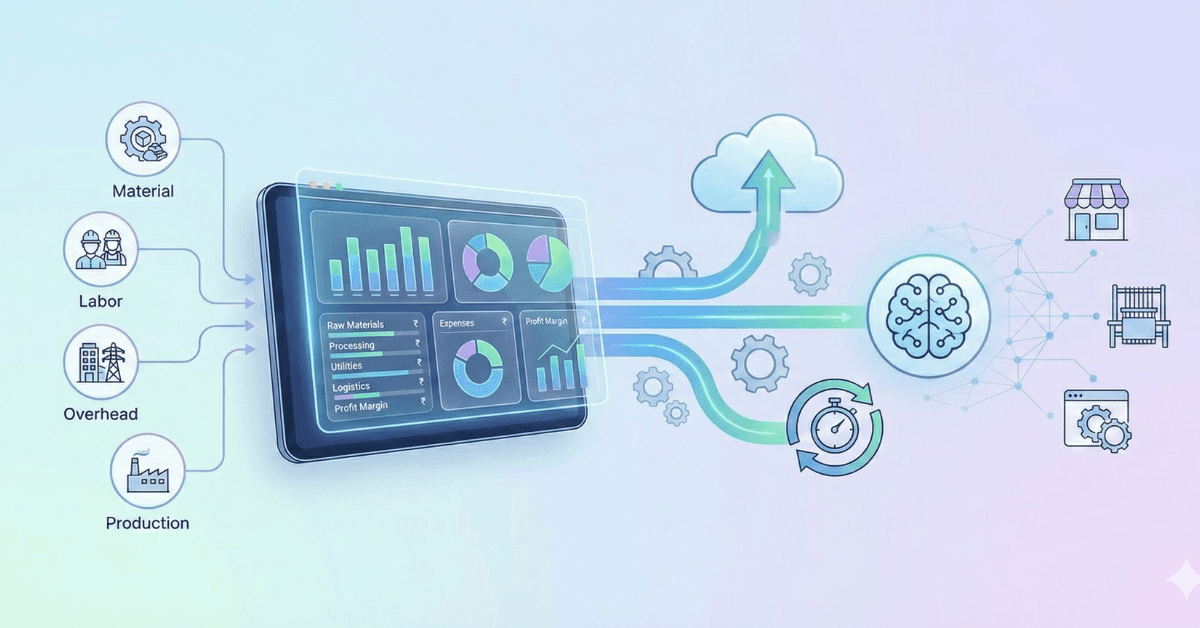
hisabkitab brings automation, AI, and cloud convenience to the entire system.
How hisabkitab Helps With Cost Accounting
1. Automatic Expense Categorization
hisabkitab automatically groups expenses into:
direct
indirect
fixed
variable
overheads
No manual classification needed.
2. Item-Level Cost Tracking
For manufacturing & trading:
raw material cost
purchase price fluctuations
landed cost
production cost
packaging cost
All calculated automatically.
3. Project / Job Costing
Perfect for:
agencies
CAs & professionals
service companies
construction firms
Track:
labour
tools
overhead
time spent
vendor bills
→ See profit per project instantly.
4. AI-Based Cost Insights
hisabkitab’s AI engine helps:
predict rising cost areas
suggest ideal pricing
highlight loss-making items
track month-on-month cost trends
5. Inventory + Cost Integration
Real-time costing based on:
purchase rates
BOM
stock movement
wastage
production cycles
6. Cost Reports in One Click
hisabkitab generates:
Cost sheets
Margin analysis
Break-even report
Profit per product
Expense trend report
Job costing summary
Perfect for decision-making & investor reporting.
Who Should Use Cost Accounting?
Cost accounting is essential for:
✔️ Manufacturers
✔️ Traders & wholesalers
✔️ Startups
✔️ Restaurants & cloud kitchens
✔️ Agencies & professionals
✔️ Service businesses
✔️ CAs managing multiple clients
If you're in business, cost accounting isn’t optional anymore.
Benefits of Using hisabkitab for Cost Accounting
✔ Increased Profitability
Find leakages, optimise spending.
✔ Better Pricing Decisions
Sell confidently with correct costs.
✔ Stress-Free Tax Compliance
Automatically maps GST, TDS, expenses, ledgers.
✔ AI-Based Financial Insights
Know what to change before problems happen.
✔ No More Excel Chaos
Cloud + automation = zero errors.
Conclusion: Cost Accounting Is Your Profit Engine
Businesses that implement cost accounting grow 30–50% faster and reduce unnecessary expenses significantly.
With automated tools like hisabkitab, even small businesses and early-stage startups can manage cost accounting professionally—without hiring a full finance team.
👉 Cost accounting tells you the truth behind your business numbers.
hisabkitab automates that truth.
Continue Reading