



Introduction
April marks the beginning of a new financial year, making it one of the most critical months for businesses, accountants, and finance teams in India. Along with starting fresh books, businesses must also handle multiple compliance responsibilities like GST filings, TDS payments, and annual returns.
Missing even a single deadline can result in penalties, interest, and unnecessary compliance issues. That’s why having a clear April 2026 compliance calendar is essential for smooth operations.
In this guide, we cover all important GST due dates April 2026, TDS payment due dates, GSTR-1 and GSTR-3B filing dates, and other key compliance requirements in a simple, easy-to-understand format.
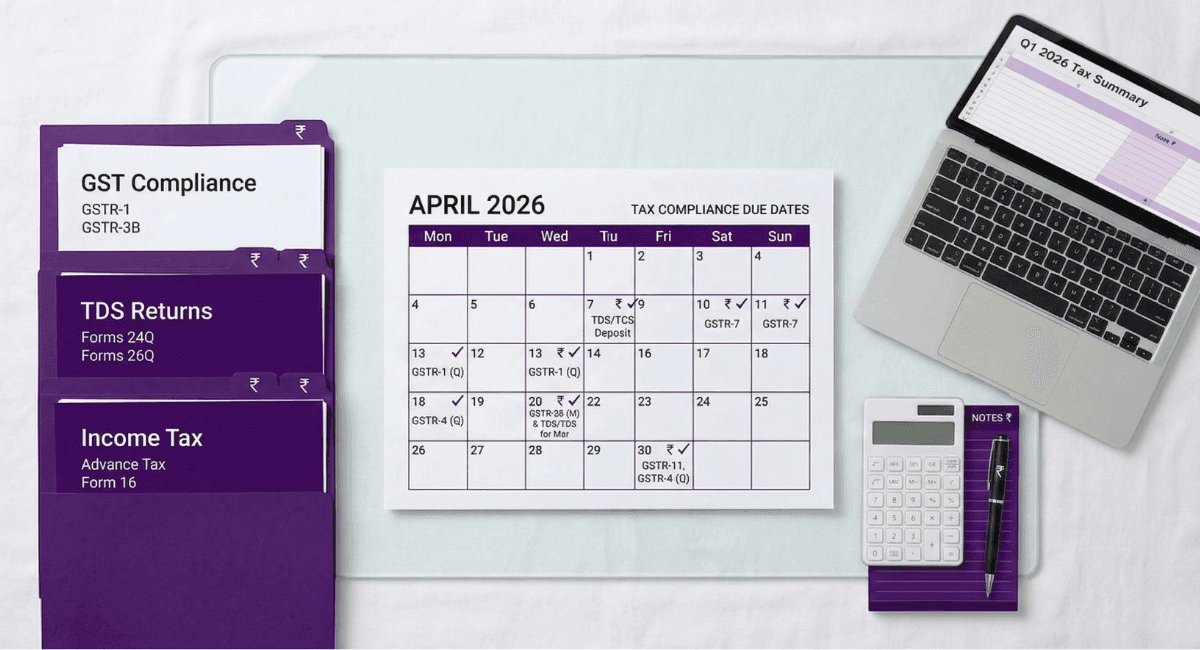
April 2026 Compliance Calendar – Complete List of Due Dates
7 April 2026 – TCS Payment for March 2026
Businesses that have collected Tax Collected at Source (TCS) must deposit it by this date.
Timely payment is important to:
Avoid interest penalties
Maintain proper tax records
Ensure smooth reconciliation
9 April 2026 – Books Setup for FY 2026–27
Although not a statutory deadline, this is one of the most important internal activities for businesses.
Key actions to take:
Create new books for FY 2026–27
Carry forward closing balances
Verify opening stock and ledgers
Clean up pending entries
A proper start ensures clean accounting throughout the year.
10 April 2026 – Income Tax e-Filing Begins (AY 2026–27)
The Income Tax portal opens for filing returns for Assessment Year 2026–27.
Businesses should:
Start preparing financial statements
Review tax liabilities
Plan early filing to avoid last-minute rush
Early preparation helps in better tax planning and smoother filing.
11 April 2026 – GSTR-1 Due Date (Monthly) for March 2026
Businesses filing monthly GST returns must submit GSTR-1 by this date.
This return includes:
Sales invoices
Debit and credit notes
Export details
Timely filing ensures:
Correct Input Tax Credit (ITC) flow
Better compliance rating
Avoidance of penalties
13 April 2026 – GSTR-1 (QRMP) for Jan–March 2026
Taxpayers under the QRMP scheme must file GSTR-1 for the quarter Jan–March 2026.
This is crucial for:
Reporting quarterly sales
Ensuring ITC availability to customers
18 April 2026 – CMP-08 (Composition Scheme) for Jan–March 2026
Businesses under the composition scheme must file CMP-08.
This form is used to:
Declare turnover
Pay tax for the quarter
Timely filing ensures compliance under the composition scheme.
20 April 2026 – GSTR-3B Filing Date for March 2026
All monthly GST filers must submit GSTR-3B.
This includes:
Summary of outward and inward supplies
ITC claimed
Tax payable
Missing this GSTR-3B filing date leads to late fees and interest.
22 April 2026 – GSTR-3B (QRMP – South India)
Quarterly filers in South India must file GSTR-3B by this date.
24 April 2026 – GSTR-3B (QRMP – North India)
Quarterly filers in North India must file GSTR-3B.
30 April 2026 – Major Compliance Deadlines
April end includes multiple critical filings.
TDS Payment Due Date for March 2026
Businesses must deposit TDS deducted in March.
Late payment results in:
Interest charges
Penalties under Income Tax Act
TDS (Form 26QB, 26QC, 26QD, 26QE) – March 2026
TDS must be deposited for:
Property purchase (26QB)
Rent payments (26QC)
Contractor payments (26QD)
Crypto transactions (26QE)
GSTR-4 (Annual Return) for FY 2025–26
Composition scheme taxpayers must file GSTR-4 annual return.
This includes:
Annual turnover
Tax paid
Summary of transactions
GST QRMP Opt-in / Opt-out
Businesses can choose to:
Opt into QRMP scheme
Opt out and shift to monthly filing
This decision impacts:
Filing frequency
Cash flow
Compliance workload
Why April Compliance is Critical for Businesses
April is not just about compliance it sets the tone for the entire financial year.
Key Reasons:
Financial Year Transition
Clean books ensure accurate reporting throughout the year.
GST Compliance Continuity
Timely filings maintain ITC flow and avoid notices.
Tax Planning Opportunity
Early planning helps optimize tax liability.
Avoiding Penalties
Late filings can lead to unnecessary costs.
Common Mistakes Businesses Should Avoid
Missing GST filing deadlines
Delaying TDS payments
Not setting up books properly
Ignoring reconciliation
Waiting till last minute for filings
Avoiding these mistakes can save both time and money.
How hisabkitab Helps You Stay Compliant
Managing multiple compliance deadlines manually can be overwhelming for small businesses.
hisabkitab simplifies compliance by:
Tracking all GST, TDS, and tax due dates
Sending reminders for important deadlines
Generating GST-ready reports instantly
Maintaining real-time books
Reducing manual accounting work
With automation and smart tracking, businesses can stay compliant without stress.
Conclusion
April is one of the most important months in the financial calendar for Indian businesses. From GST returns and TDS payments to income tax preparation and book setup, every compliance activity plays a crucial role.
Following this April 2026 compliance calendar helps businesses stay organised, avoid penalties, and maintain smooth financial operations.
Starting the year with proper compliance and clean books ensures better financial control and long-term growth.
If you want to simplify accounting, track compliance deadlines, and reduce manual work, using a modern cloud accounting solution like hisabkitab can help you stay organised and stress-free throughout the year.
Looking ahead? We've broken down all the May 2026 Tax Compliance Deadlines → in the same simple format TDS, TCS, Form 61A and more, all explained with real tips.
Continue Reading