How to Track Profit Across Amazon, Flipkart, Meesho & Shopify in One Place
Selling across multiple marketplaces can help an e-commerce business grow faster. But once orders start coming from Amazon, Flipkart, Meesho, and Shopify, one question becomes surprisingly difficult to answer:
“How much profit did I actually make?”
Your marketplace dashboard may show ₹10 lakh in sales. Your bank account may show several lakh rupees in credits. But neither number tells you the complete picture.
Marketplace commission, shipping charges, returns, GST, TCS, discounts, settlement adjustments, and product costs can all change the final margin.
For growing sellers, checking every marketplace separately and maintaining spreadsheets can quickly become difficult.
This is where a centralized accounting and settlement workflow can make a difference.
With hisabkitab, businesses can manage accounting, billing, inventory, GST, and e-commerce settlement information in one place helping business owners get a clearer view of sales, deductions, collections, and profitability.
Why Marketplace Sales Don't Equal Profit
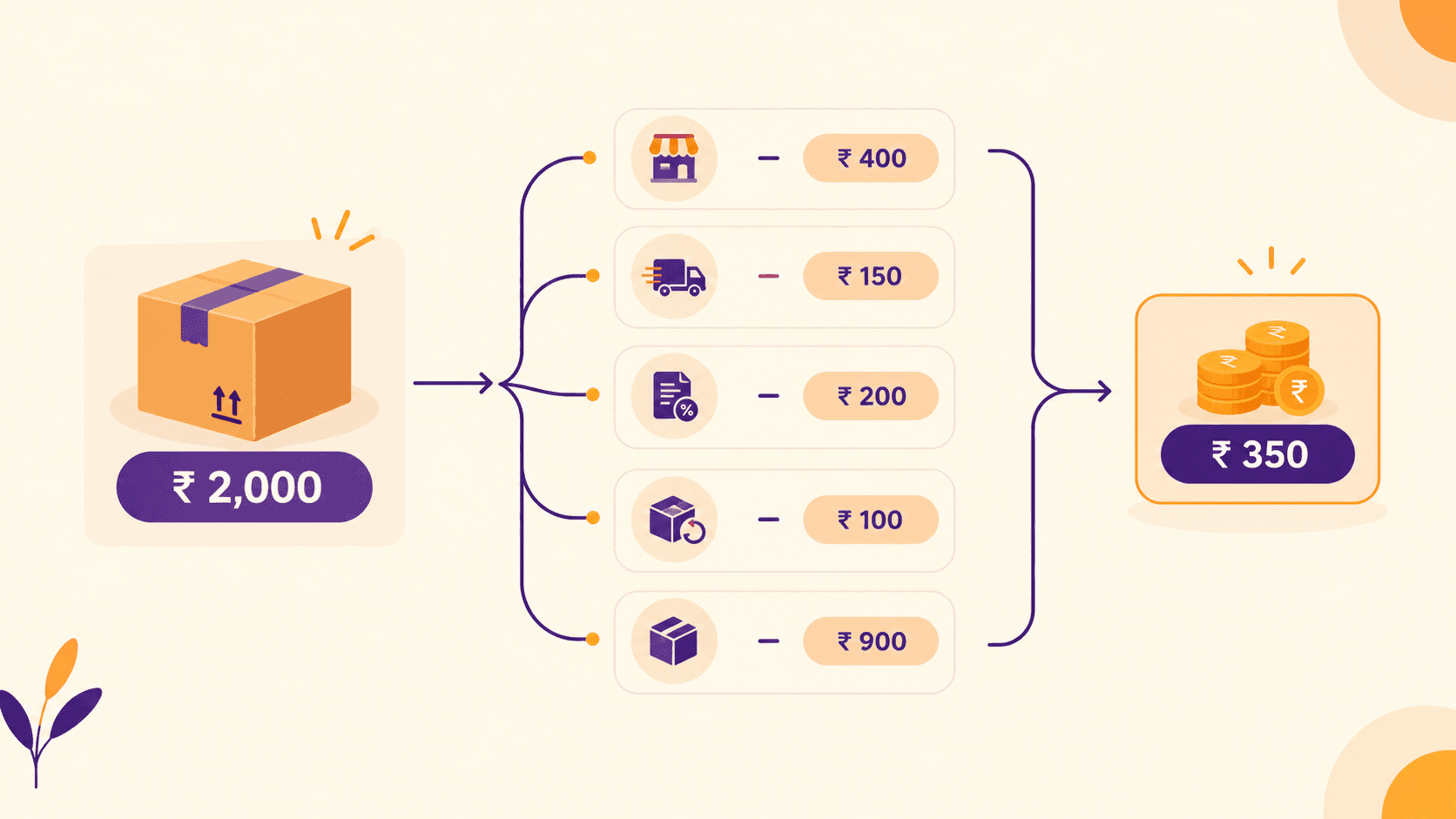
Imagine you sell a product for ₹2,000 on Amazon.
At first glance, it looks like you made ₹2,000.
But the actual calculation may look more like this:
Particular | Amount |
|---|---|
Selling Price | ₹2,000 |
Marketplace Charges | -₹250 |
Shipping/Other Charges | -₹100 |
GST/TCS/TDS Adjustments | -₹80 |
Product Cost | -₹1,000 |
Approx. Profit | ₹570 |
So, looking only at sales can give you the wrong picture.
Now imagine handling thousands of such orders across four different sales channels.
That's where tracking profit manually becomes difficult.
The Real Challenge for Multi-Channel Sellers

A business selling through Amazon, Flipkart, Meesho, and Shopify usually has multiple streams of data:
Orders
Sales invoices
Returns
Marketplace fees
Shipping charges
Discounts
TCS/TDS
GST
Settlement amounts
Payment collections
Product costs
Inventory
Bank transactions
The problem isn't necessarily that the data doesn't exist.
The problem is that the data is scattered.
You may find sales data in Amazon Seller Central, settlement information somewhere else, Shopify orders in another dashboard, and accounting records in Excel or accounting software.
That makes a simple question Which channel is actually making me money? much harder to answer.
What You Need to Track Profit Properly
To calculate actual marketplace profitability, don't stop at sales revenue.
You need to connect four important areas.
1. Sales Revenue
Start with the actual value of products sold through each channel.
Track:
Total orders
Sales value
Discounts
Sales returns
GST
Cancelled orders
This gives you the revenue side of the calculation.
2. Marketplace Deductions
This is where many sellers lose visibility.
Depending on the marketplace and order, deductions can include:
Commission
Shipping charges
Platform fees
Return charges
Other marketplace adjustments
TCS
TDS
A product that appears profitable based on its selling price may have a much lower margin after these deductions.
3. Product Cost
Your actual profit also depends on what the product costs you.
For example:
Selling Price – Marketplace Charges – Product Cost = Gross Contribution
If your product sells for ₹1,500 but costs ₹1,100 to purchase or manufacture, the remaining amount isn't automatically your profit.
You still need to account for marketplace deductions and other business expenses.
4. Settlement Amount
Finally, look at what the marketplace actually settles.
This is important because:
Sales ≠ Settlement
A marketplace can deduct different charges before the amount reaches your bank account.
So, comparing only your sales report with bank credits can leave unexplained differences.
How to Track Amazon, Flipkart, Meesho & Shopify Together
Instead of maintaining four separate spreadsheets, create a centralized workflow.
Your basic structure should look like this:
Marketplace Sales → Orders & Returns → Fees & Deductions → GST/TCS/TDS → Settlement → Product Cost → Actual Profit
This gives you a much more realistic picture of business performance.
For example:
Channel | Sales | Deductions | Product Cost | Approx. Profit |
|---|---|---|---|---|
Amazon | ₹4L | ₹70K | ₹2L | ₹1.3L |
Flipkart | ₹3L | ₹55K | ₹1.5L | ₹95K |
Meesho | ₹2L | ₹35K | ₹1L | ₹65K |
Shopify | ₹2.5L | ₹25K | ₹1.2L | ₹1.05L |
Now the business owner can see something that a simple sales report won't show:
Which channel is actually contributing more profit?
Where hisabkitab Helps
For businesses selling across multiple channels, hisabkitab brings accounting and e-commerce data closer together.
Its e-commerce capabilities can help businesses work with Amazon, Flipkart, Meesho, and Shopify, while also managing their accounting and business operations.
Marketplace Settlement Tracking
Instead of looking only at order value, you can work with settlement information and the deductions behind it.
This helps you understand where the money from your marketplace sales is actually going.
Sales & Settlement Entries
Marketplace sales and settlement-related information can be reflected in your accounting workflow, reducing the need to manually create every entry.
Track Marketplace Charges
Different marketplace deductions can impact your margins.
Keeping these charges visible makes it easier to understand your actual earnings instead of relying on gross sales.
Returns & Adjustments
Returns can significantly change marketplace profitability.
A product may generate good sales but have frequent returns that reduce its actual contribution.
Tracking these adjustments helps you evaluate the channel more realistically.
GST, TCS & TDS
For Indian e-commerce sellers, tax-related deductions are another important part of reconciliation.
Keeping sales, settlement and tax-related information connected can make the accounting process easier to manage.
A Simple Example
Suppose you sell the same product on four channels.
Your monthly sales are:
Amazon — ₹5 lakh
Flipkart — ₹3 lakh
Meesho — ₹2 lakh
Shopify — ₹4 lakh
Your total sales are therefore:
₹14 lakh
It may look like a very profitable month.
But after considering marketplace charges, returns, product costs and other deductions, the actual contribution could be significantly lower.
This is why business owners should avoid asking only:
“How much did we sell?”
Instead, ask:
“How much did we keep?”
That's the number that matters.
Why a Centralized Profit View Matters
When all channels are tracked separately, you may notice that sales are increasing but still struggle to understand why cash flow isn't improving at the same pace.
A centralized view can help you identify:
Which marketplace has the highest sales?
Useful for understanding where your volume is coming from.
Which marketplace has the best margins?
High sales don't necessarily mean high profitability.
Which products generate the most profit?
This can help you decide which products deserve more inventory and marketing investment.
Where are returns hurting margins?
A high-return product can look successful until you calculate its actual contribution.
How much are marketplace charges affecting profitability?
This can help you compare channels more realistically.
Don't Track Only Marketplace-Wise Profit
There is another important layer.
You should also look at SKU-wise profitability.
For example, suppose Product A generates:
₹5 lakh sales on Amazon
₹2 lakh sales on Flipkart
₹1 lakh sales on Meesho
And Product B generates:
₹3 lakh sales across the same channels
Product A has higher revenue.
But after marketplace fees, returns, discounts and product costs, Product B could actually generate a better margin.
So your analysis should ideally answer both:
Which marketplace is profitable?
and
Which product is profitable?
That's where accounting and inventory data become important together.
What About Shopify?
Shopify works slightly differently from marketplaces.
With your own store, you have more control over the customer relationship and storefront, but you still need to account for:
Product cost
Payment gateway charges
Discounts
Shipping
Returns
GST
Marketing costs
Refunds
So Shopify sales should also be evaluated based on actual contribution, not simply gross order value.
A centralized accounting system can make it easier to compare your own website against marketplace channels.
7 Numbers Every E-Commerce Seller Should Watch
If you're selling across multiple channels, don't limit your dashboard to total sales.
Keep an eye on:
1. Gross Sales
How much did customers purchase?
2. Returns
How much revenue was reversed?
3. Marketplace Deductions
How much did platforms charge?
4. Settlement Amount
How much was actually settled?
5. Product Cost
What did those sales cost the business?
6. Contribution Margin
How much remains after the key direct costs?
7. Channel-Wise Profitability
Which platform is actually contributing to the business?
These numbers together give a much clearer picture than sales alone.
From Marketplace Sales to Actual Business Profit
For a growing e-commerce business, accounting shouldn't be limited to recording invoices.
You need to connect the entire journey:
Order → Invoice → Sale → Return → Marketplace Deduction → Settlement → Bank → Accounting → Profit
When these pieces are disconnected, business owners spend more time reconciling spreadsheets and less time understanding the business.
When they are brought together, it becomes easier to answer questions like:
Which marketplace is performing best?
Which products are actually profitable?
Where are returns increasing?
How much are marketplace fees costing us?
Are settlements matching our expectations?
Is revenue growing faster than profit?

Why hisabkitab for Multi-Channel Sellers?
hisabkitab is designed to bring accounting, GST, billing, inventory and business data into one connected workflow.
For e-commerce sellers, that means you don't have to think about marketplace sales as just another order report.
You can look at the bigger picture sales, settlements, deductions, returns, accounting and profitability.
And as your business expands from one channel to multiple channels, having that information in one place can make financial tracking much easier.
Final Takeaway
Selling on Amazon, Flipkart, Meesho and Shopify can create multiple revenue streams.
But more channels also mean more data, more deductions, more settlements and more reconciliation.
₹14 lakh in sales doesn't necessarily mean ₹14 lakh worth of business success.
The better question is:
After product costs, returns, marketplace charges, taxes and other deductions, how much did the business actually make?
That's why multi-channel sellers need to track profit not just sales.
With hisabkitab, businesses can bring their accounting, GST, inventory and e-commerce settlement workflow closer together, giving business owners a clearer view of where their money is coming from and where it is going.
Ready to get a clearer view of your e-commerce business? Book a FREE demo with HisabKitab.
Continue Reading