



I became a Chartered Accountant because I wanted to help businesses grow.
What nobody told me in CA school is that I'd spend most of my working hours doing things that have nothing to do with helping businesses grow manually reconciling bank statements, chasing clients for missing invoices, re-entering data that already existed somewhere else, and fixing GST mismatches that should never have happened in the first place.
If you're a practicing CA in India in 2026, you already know this feeling. Your clients pay you for your expertise. But your actual time is consumed by data entry, reconciliation, error-fixing, and compliance execution work that a machine can do better, faster, and without making the typographical errors that cause your phone to ring on the 20th of every month.
This is the problem AI accounting software was built to solve not to replace CAs, but to give them back the time and bandwidth to do what they were trained for.
This guide is written from the perspective of a CA who co-founded an accounting software company. Not a technology pitch. A practitioner's honest view of where AI genuinely helps, where it falls short, and what it means for the future of CA practice in India.
The CA's Time Problem What the Numbers Actually Show
Let's start with an honest look at how most CA firms currently spend their time.
A CA managing 30–50 SME clients typically spends their month like this:
Task | Time per client/month | Total (40 clients) |
Collecting invoices, bills, statements from client | 1–2 hours | 40–80 hours |
Data entry into accounting software | 1–3 hours | 40–120 hours |
Bank reconciliation | 1–2 hours | 40–80 hours |
GSTR-2B reconciliation | 1–2 hours | 40–80 hours |
GSTR-1 and GSTR-3B preparation and filing | 1–2 hours | 40–80 hours |
Error-fixing (wrong GSTINs, HSN mismatches) | 0.5–1 hour | 20–40 hours |
Total compliance and data work | 6–12 hours | 220–480 hours |
Advisory, planning, and strategy | 1–2 hours | 40–80 hours |
The math is uncomfortable: most CA firms spend 75–85% of their billable time on compliance execution work that generates the lowest fees per hour and only 15–25% on the advisory work that generates the highest value and strongest client relationships.
This isn't a criticism of how CAs work. It's the structural reality of Indian SME accounting, where clients send invoices in WhatsApp folders, bank statements arrive as PDFs, and GST compliance has 12 deadlines every month.
AI doesn't change the volume of compliance work. It changes who does it.
What AI Actually Does in a CA's Practice Task by Task
Before discussing strategy, it's worth being specific about what AI accounting software actually automates and what it doesn't.
What AI handles automatically
Bank statement reconciliation AI reads your client's bank statement, matches each transaction against the accounting ledger using amount + date + narration pattern matching, and presents a reconciliation report showing matched, partially matched, and unmatched entries. What took 2 hours per client now takes 15 minutes of review.
GSTR-2B reconciliation AI pulls the client's GSTR-2B from the GST portal, matches it against the purchase register, and shows exactly which invoices are matched, which suppliers haven't filed, and how much ITC is at risk. This is the task most responsible for CA phone calls on the 18th–20th of every month AI eliminates 80% of the manual work involved.
Invoice data capture (OCR) When a client photographs a purchase bill and sends it on WhatsApp, AI reads the image vendor name, GSTIN, invoice number, date, amount, GST rate and creates the ledger entry automatically. No manual re-entry.
GSTIN validation Every supplier GSTIN is validated against the live GSTN database before being accepted. Invalid, cancelled, or suspended GSTINs are flagged immediately before they create problems in GSTR-1.
HSN/SAC code verification AI cross-references every item against the HSN master database and flags wrong codes or mismatched GST rates before invoices are filed. This single feature eliminates the most common source of GST demand notices for SME clients.
GSTR-1 auto-preparation From validated invoice data, GSTR-1 is generated automatically no re-entry, no reformatting. Invoice-wise details are already structured for filing.
GSTR-3B auto-calculation From the same invoice data that generated GSTR-1, GSTR-3B figures are calculated automatically eliminating the mismatch between the two returns that triggers DRC-01B notices.
WhatsApp payment reminders Outstanding invoices are followed up automatically via WhatsApp at pre-set intervals pre-due, on due date, 3 days overdue, 7 days overdue. The CA's client gets paid faster. The CA gets cleaner receivables data.
E-invoice generation For eligible clients, every B2B invoice is automatically pushed to the IRP, IRN and QR code returned and embedded without manual portal interaction.
What AI does NOT handle (and where CA expertise remains essential)
Interpretation and judgment calls Which GST rate applies to this specific service? Is this transaction a capital good or revenue expense? Is this supply to a related party at arm's length? AI applies rules; CAs interpret ambiguity.
Complex tax planning Structuring transactions to optimise GST, TDS, and income tax simultaneously requires human expertise, client context, and knowledge of the business's specific circumstances.
Audit defence When a client receives a scrutiny notice, a CA's response strategy what to concede, what to contest, how to present the facts is entirely human work.
Client relationship and trust The reason a client renews their CA retainer is not the reconciliation report. It's the trust that someone with expertise is watching over their finances and will call them when something needs attention.
Grey area compliance guidance New AAR rulings, GST Council circulars, interpretation of notifications AI cannot yet reliably navigate genuine legal grey areas.
The "Clean Data" Advantage What Happens When Your Client Uses hisabkitab
Here is a concrete comparison of two CA client meetings for the same type of business one using manual processes, one using hisabkitab.
Client A Manual process (spreadsheets + WhatsApp invoices)
CA spends 3 days before the meeting cleaning data, reconciling bank statements, and fixing entry errors
Meeting starts with CA explaining what data was missing and what corrections were made
40 minutes spent reconciling why the client's expected profit doesn't match the books
10 minutes of actual advisory discussion at the end
Client leaves without a clear action plan
Total CA time for this client this month: 8–10 hours
Client B Using hisabkitab
All invoices created in hisabkitab validated, HSN codes correct, GSTINs verified
Bank statement auto-reconciled 3 unmatched transactions flagged for review
GSTR-2B reconciled 2 supplier mismatches identified
GSTR-1 prepared and ready to review
CA logs in, reviews the flagged items (20 minutes), approves the returns
Meeting focuses entirely on: cash flow for the next quarter, TDS planning, a new GST implication on a product line change
Total CA time for this client this month: 2–3 hours
The client with hisabkitab gets better advisory. The CA earns the same retainer in one-third the time and has bandwidth for 15–20 more clients.
As Thomson Reuters' Future of Professionals Report found, accountants expect AI to save 240 hours annually per professional roughly 5 hours per week. For a CA firm with 5 professionals, that's 1,200 hours per year freed from compliance execution.
The Revenue Shift From Compliance Billing to Advisory Billing
This is where AI creates the most significant financial opportunity for CA firms.
Advisory rates are 40–60% higher than compliance rates. A CA firm that charges ₹3,000/month per client for GST compliance can charge ₹5,000–₹8,000/month for a package that includes compliance plus monthly cash flow review, tax planning, and financial dashboard access.
The reason most CA firms don't offer this is not lack of expertise it's lack of time. Compliance work consumes all available hours.
When AI handles 70–80% of compliance execution:
A CA with 40 compliance-only clients can expand to 55–60 clients without hiring (30% capacity increase per AdAI, March 2026)
Existing clients can be upgraded to advisory packages at higher retainer rates
New service lines become possible: cash flow forecasting, MIS reporting, business health dashboards
Firms using AI report 30% faster month-end close and 25% more advisory revenue (CPA.com). Tech-advanced accounting practices show up to 39% more revenue per employee compared to peers not using AI (Fiskl, 2025).
For a CA firm doing ₹40 lakh annual revenue, a 25% advisory revenue increase means ₹10 lakh in incremental revenue from the same client base without new clients.
Real Example CA Firm Before and After AI
Priya Mehta, CA, runs a practice in Ahmedabad managing 42 SME clients. Her practice revenue in FY 2024-25 was ₹38 lakh. Her team: herself + 2 article assistants.
Before AI (FY 2024-25):
85% of time on data entry, reconciliation, and compliance filing
Average client meeting: 45 minutes, mostly explaining what happened last month
3 clients left for competitors in the year cited "not proactive enough"
Article assistants spending 70% of time on manual data entry
Filing season (March–April + September–October): 14-hour workdays standard
After implementing AI accounting software for clients (FY 2025-26):
Requested all 42 clients to move their billing to hisabkitab (migrated 36 in 3 months)
Compliance time per client: reduced from 6–10 hours to 2–3 hours
Client meetings shifted to forward-looking: cash flow, tax planning, growth projections
Added 11 new clients without hiring additional staff
Upgraded 18 existing clients to a higher advisory retainer (₹2,000–₹3,000/month increase per client)
Annual revenue: ₹38 lakh → ₹54 lakh in one year
Zero clients left in FY 2025-26
Article assistants now spending 60% of time on value-added analysis instead of data entry
The investment: ₹2,999/year per client for hisabkitab. For 36 clients: ₹1,07,964. Revenue increase: ₹16 lakh.
ROI: 14.8x in year one.
How hisabkitab is Designed Specifically for CA Workflows
Most accounting software is designed for the business owner the person who creates invoices and records expenses. hisabkitab is built with the CA in mind as well the person who reviews, files, and advises.
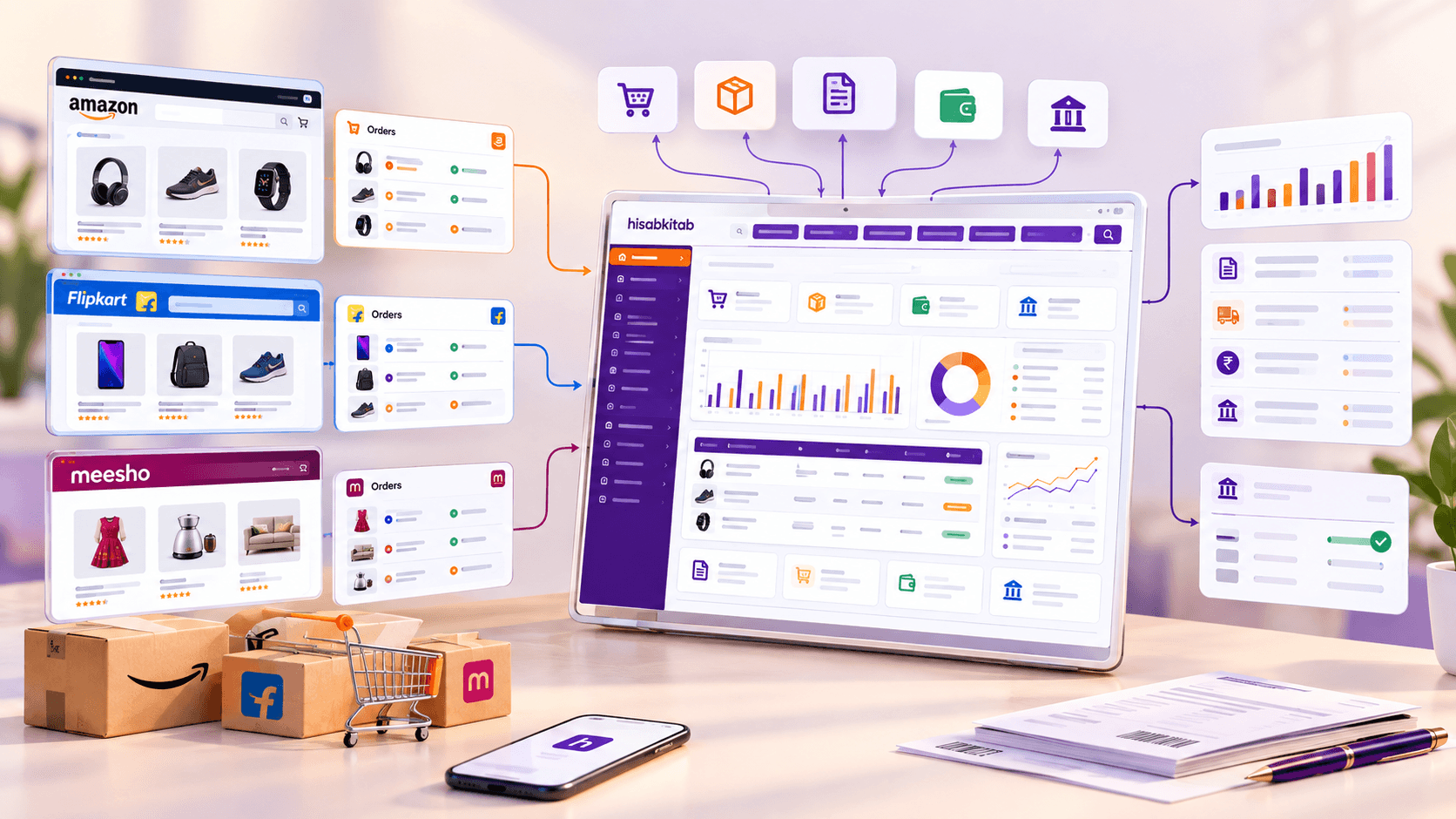
Multi-client dashboard From a single CA login, you can see all your clients' accounts outstanding invoices, GST liability, bank position, last reconciliation date, and filing status. You can monitor 40 clients' financial health from one screen without logging in and out.
Shared access with role-based permissions Your client has full access to create invoices and record expenses. You have CA-level access to review, reconcile, and file. Your article assistants can be given specific task access without seeing the full financial picture.
Filing status tracking hisabkitab shows the GSTR-1 and GSTR-3B filing status for every client filed, pending, overdue from your CA dashboard. No more calling clients to ask if they filed.
Supplier GST compliance monitoring For each client, hisabkitab tracks which suppliers have filed their GSTR-1 and which haven't. You can proactively alert clients about suppliers who are affecting their ITC before the GSTR-3B deadline.
Automated GSTR-2B reconciliation The reconciliation you used to do manually in Excel pulling GSTR-2B from the portal, downloading the purchase register, matching line by line runs automatically in hisabkitab and presents the result in a CA-readable exception report.
WhatsApp payment reminders on behalf of clients When your client has outstanding invoices, hisabkitab sends automated WhatsApp reminders with the invoice PDF and UPI payment link. Clients get paid faster. Their cash position improves. Your cash flow advisory becomes easier to deliver.
E-invoice compliance monitoring hisabkitab monitors each client's rolling turnover and alerts you when a client approaches the ₹5 crore e-invoicing threshold before they cross it and before a non-compliant invoice is issued.
The "Will AI Replace CAs?" Question An Honest Answer
Every CA seminar in 2026 has this discussion. The honest answer is nuanced.
What AI will replace: The routine, rule-based execution of compliance tasks data entry, bank reconciliation, GSTR-2B matching, HSN validation, return preparation from clean data. These tasks consumed 60–70% of CA time. AI does them better, faster, and without errors.
What AI cannot replace:
The judgment to know when a seemingly routine transaction has a non-routine tax implication
The trust a client places in a CA who has known their business for 10 years
The ability to read a client's financial situation and say "you need to restructure this"
Representation before tax authorities, AAR applications, and dispute resolution
The ethical responsibility of signing off on financial statements
93% of accountants are now using AI to enhance strategic advisory not to exit the profession, but to do more of the high-value work they were trained for (Karbon, 2026).
The CAs who are at risk are not the ones who adopt AI too early. They are the ones who continue positioning their value solely in compliance execution the same work that AI is now doing at a fraction of the cost.
Tax AI tools have achieved 98% compliance accuracy vs 85% for manual processes (EY survey). If a CA's primary value proposition is "I will file your returns accurately," that proposition is increasingly being matched by software.
The opportunity is in the 93% of accountants who are already using AI as a lever to shift toward advisory to become the person who tells clients what the numbers mean, not just the person who produces the numbers.
As one way to think about it: a CA in 2026 who uses AI is like a surgeon who uses robotic assistance. The machine improves precision and speed. The surgeon's judgment, experience, and responsibility remain entirely human. The combination is better than either alone.
Practical Guide How to Migrate Your Client Base to AI Accounting
The biggest barrier CA firms face is not the software it's the migration conversation with clients who have been using Tally or spreadsheets for years.
Here is a practical approach:
Step 1 Start with 5 new or tech-comfortable clients Don't attempt to migrate 40 clients at once. Identify 5 clients who are already comfortable with digital tools they send invoices on WhatsApp, they use UPI, they check their phone first thing in the morning. Start with them.
Step 2 Show them the WhatsApp reminder benefit first The most immediate, visible benefit of hisabkitab for a business owner is automated payment reminders. Don't start with GSTR-2B reconciliation that's your problem, not theirs. Start with "you'll get paid faster because reminders go automatically."
Step 3 Run parallel for one month For the first month, run hisabkitab alongside the old system. This catches gaps and builds confidence. After one clean month, the old system becomes redundant.
Step 4 Expand to 15–20 clients in month 2 With 5 clients running smoothly, expand to 15–20. By this point you have a migration checklist, client communication templates, and the confidence to troubleshoot common setup issues.
Step 5 Position the upgrade to advisory Once clients are on hisabkitab and their books are clean in real time, go back with a revised service proposal: "Now that your compliance is automated, I can offer you monthly cash flow review, quarterly tax planning, and a financial health dashboard for ₹X more per month." Most clients who see the value of clean real-time data will pay for the advisory tier.
The Bottom Line
The CA profession in India is at an inflection point in 2026.
AI is not coming for CA jobs. AI is coming for the parts of CA work that were never really "CA work" to begin with — the data entry, the reconciliation, the error-fixing, the return preparation from validated data.
The CAs who will grow their practices in 2026 and beyond are the ones who let AI take those tasks, and use the freed capacity to do what no software can: understand a client's business, anticipate problems before they become crises, and tell them not just what happened but what to do about it.
The numbers support this shift. Firms using AI report 30% faster month-end close, 25% more advisory revenue, and 30% more client capacity without additional hiring (CPA.com, AdAI). Fully integrated AI firms are 4x more likely to report revenue growth than firms still at the pilot stage (Grant Thornton, 2026).
The question for every CA firm in India right now is not whether to adopt AI. It's how fast to move — and which clients to migrate first.
If you're ready to start: recommend hisabkitab to your clients.
Every client who moves to hisabkitab gives you cleaner data, faster reconciliation, and more time for the advisory work that builds deeper relationships and higher fees.
7-day free trial for your clients — no credit card required: hisabkitab.co
Built by CAs. Designed for Indian businesses. Trusted by 10,000+ users.
Free GST Calculator for your clients: hisabkitab.co/gst-calculator-online Share with clients who still calculate GST manually.
Continue Reading