
Most small manufacturers price a product by adding up what the parts cost. A 9-watt LED bulb uses a ₹14.50 LED board, an ₹11 driver and a few smaller parts, so the owner writes ₹38.60 on a slip, adds a margin and quotes the distributor. The trouble starts when the year-end P&L shows half the profit that slip promised.
BOM costing fixes this. A bill of materials (BOM) lists every component and the quantity needed for one finished unit. Costing that BOM properly means adding the parts you lose to rejection, the labour and power that assemble them, and a fair share of the factory’s fixed costs. Done once, it gives you a cost per unit you can quote against with confidence.
This guide walks through that build-up with a worked example in rupees, then covers the three places owners usually go wrong: rejection, low-production months and GST.
What is BOM costing, and why does your selling price depend on it?
A BOM is the recipe for a product. For a garment it is fabric, thread, buttons and labels. For a pump it is the casing, motor, impeller and seals. For a namkeen pack it is besan, oil, spices and the pouch. Each line has a quantity per unit and a rate.
BOM costing turns that recipe into a cost per finished unit. It answers a plain question: if you make one more unit today, what does it really cost you? That number drives your quotation, your discount limit and the value of finished stock in your balance sheet. If it is too low, every order you win at a thin margin quietly loses money.
What goes into a BOM cost besides raw material?
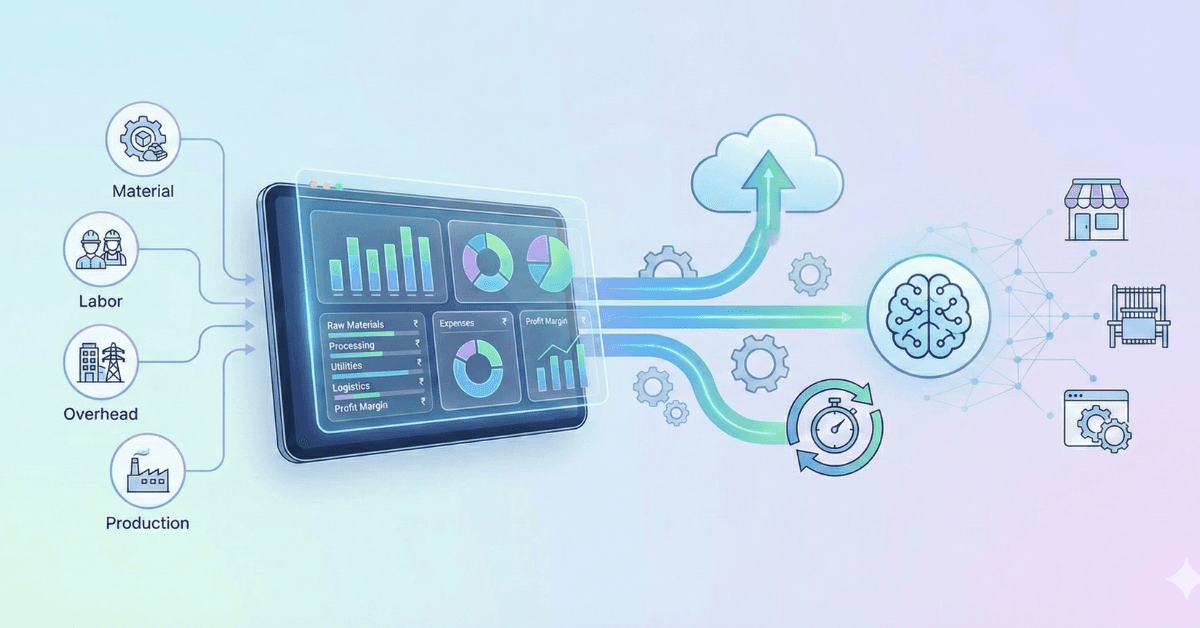
Raw material is usually the largest piece, but it is rarely the whole cost. A complete cost per unit has five layers:
Material at standard quantity. Each component multiplied by its current purchase rate, net of any GST you can claim back as credit.
Normal loss allowance. The extra material you consume because some units fail testing or get spoiled in the ordinary course of production.
Direct labour. Wages of the people who actually make or assemble the product, spread over the units they produce.
Direct expenses. Power for a machine line, consumables, job work charges paid for a specific process.
Fixed production overhead. Factory rent, supervisor salary, machine depreciation and repairs, spread over the units the factory normally produces.
Selling and admin costs such as the office staff, sales commission and freight to customers stay out of the product cost. They belong in your P&L for the period, not in the value of a unit of stock.
A worked example: costing a 9-watt LED bulb
Say you run a small LED bulb assembly unit in Rajkot. You buy components, assemble, test and pack 9-watt B22 bulbs for distributors. All rates below are exclusive of GST, because you claim input tax credit on purchases.
Step 1: The bill of materials for one bulb
Component | Quantity per bulb | Rate (₹) | Cost per bulb (₹) |
|---|---|---|---|
LED board with chips | 1 pc | 14.50 | 14.50 |
Driver | 1 pc | 11.00 | 11.00 |
Housing | 1 pc | 6.40 | 6.40 |
Diffuser dome | 1 pc | 2.80 | 2.80 |
B22 cap | 1 pc | 1.90 | 1.90 |
Thermal adhesive | 0.5 g | 0.80 per g | 0.40 |
Carton | 1 pc | 1.60 | 1.60 |
Total material | 38.60 |
That ₹38.60 is the number on the owner’s slip. It assumes every bulb you start becomes a bulb you sell.
Step 2: Allow for normal rejection
Your testing bench rejects about 2% of assembled bulbs in a normal batch. To pack 2,000 good bulbs, you assemble 2,040. The 40 rejects use up every component except the carton, which goes on only after testing.
Components for 2,040 assemblies: 2,040 × ₹37.00 = ₹75,480
Cartons for 2,000 good bulbs: 2,000 × ₹1.60 = ₹3,200
Less scrap sold from rejects: 40 × ₹3 = ₹120
Net material for the batch: ₹75,480 + ₹3,200 − ₹120 = ₹78,560
Spread over 2,000 good bulbs, material is ₹39.28 per bulb, not ₹38.60.
Step 3: Add labour, power and fixed overhead
Labour: three assemblers take two days for the batch at ₹700 a day each, so 3 × 2 × ₹700 = ₹4,200, or ₹2.10 per bulb.
Power and soldering consumables: ₹900 for the batch, or ₹0.45 per bulb.
Fixed overhead: rent, the supervisor’s salary and depreciation on the testing rig come to ₹1,20,000 a month. The unit normally makes 40,000 bulbs a month, so the rate is ₹1,20,000 ÷ 40,000 = ₹3.00 per bulb, or ₹6,000 for this batch.
Step 4: The real cost per bulb
Batch cost: ₹78,560 + ₹4,200 + ₹900 + ₹6,000 = ₹89,660. Divided by 2,000 good bulbs, that is ₹44.83 per bulb.
Now look at the margin. At a distributor price of ₹52, the slip suggested a margin of ₹13.40, about 25.8%. The real margin is ₹52 − ₹44.83 = ₹7.17, about 13.8%. Offer a 10% scheme discount on the strength of the slip and you are selling at ₹46.80, barely above cost.
How should you treat rejection, scrap and abnormal loss?
The 40 rejects in the example are a normal loss. They happen in almost every batch, so their cost is part of the cost of the good bulbs. Any money you recover from selling the scrap reduces that cost, which is why the ₹120 was deducted.
An abnormal loss is different. Suppose a bad lot of drivers causes 200 rejects in one batch instead of the usual 40. The extra 160 assemblies cost 160 × ₹37.00 = ₹5,920. That amount should not be loaded onto the good bulbs. Under the accounting standard on inventories, AS 2, abnormal amounts of wasted material, labour or other production costs are excluded from the cost of inventory and recognised as an expense in the period. Book it as an abnormal loss, and raise a claim on the driver supplier if the lot was defective.
Keeping the two apart matters for decisions as well as for the accounts. If you average a bad month’s rejection into your BOM cost, you will quote too high for the next six months and lose orders you could have won.
How do you absorb fixed overheads when production is low?
The ₹3.00 overhead rate was worked out on normal capacity of 40,000 bulbs a month, not on whatever you happened to make. AS 2 requires fixed production overheads to be allocated to stock on the basis of normal capacity, with the unabsorbed portion charged to the P&L in a low-production period.
Say Diwali leave and a component shortage bring November output down to 25,000 bulbs. The stock you made still carries ₹3.00 per bulb, or ₹75,000. The other ₹45,000 of that month’s overhead goes straight to the P&L as a cost of the period. It does not raise the value of the bulbs sitting in your godown.
Owners often do the opposite and divide ₹1,20,000 by 25,000, getting ₹4.80 per bulb. That inflates closing stock, overstates profit for the year and gives a misleading cost for quoting. When orders are thin is exactly when you need an honest cost to price against.
Does GST belong in your BOM cost?
Only when you cannot claim it back. If you are a regular GST-registered manufacturer and the credit on components is available, the GST you pay is recovered through input tax credit, so it stays out of the cost. AS 2 says the same thing in accounting terms: cost of purchase excludes taxes that the business later recovers from the tax authorities.
There are two common exceptions. A manufacturer under the composition scheme cannot claim input tax credit, so GST paid on components is part of material cost and should be built into each BOM rate. And if credit on a particular purchase is blocked or reversed, that tax becomes a cost too. Check this when you set up the BOM, not after the year closes.
How often should you update BOM rates?
A BOM with last year’s rates is only slightly better than no BOM. A simple routine keeps it honest:
After every purchase of a major component, update its rate in the BOM. In the example, a driver price rise from ₹11.00 to ₹12.20 adds about ₹1.22 per good bulb once the 2% rejection allowance is included (₹1.20 × 2,040 ÷ 2,000).
Every month, compare actual material consumed in production entries with the BOM quantity for the units made. A gap of more than a percent or two means the recipe, the rejection rate or the stock records are off.
Every quarter, recheck labour time per batch and the overhead rate against current rent, salaries and normal output.
Before any large quotation or scheme, recompute the cost per unit from the latest BOM rather than the price list you quoted last season.
Cost overruns rarely come from one big mistake. They creep in through small rate changes nobody carried into the BOM. Our earlier piece on reducing manufacturing costs without hurting quality covers what to do once the true cost is visible, and the challenges MSMEs face as they scale explains why costing slips as volumes grow.
Where hisabkitab fits in
The arithmetic above is easy once. Keeping it current across fifty products is where spreadsheets break. On the MFG plan, hisabkitab lets you define a BOM for each finished item, record production entries, and post consumption of components against the BOM, so the stock of components and finished goods moves together. Purchase bills can be read with AI OCR, which keeps component rates in the books up to date without retyping every invoice.
With production and consumption recorded in the same books as sales and purchases, your P&L and stock reports reflect what the factory actually used. You can see the full list of accounting software features, including manufacturing, on the features page.
Frequently asked questions
What is the difference between a BOM and BOM costing?
A BOM lists the components and quantities needed for one unit of a product. BOM costing puts rates against those quantities and adds rejection allowance, labour, direct expenses and fixed overhead to arrive at a cost per finished unit.
Should labour and overheads be part of the product cost?
Direct labour and fixed production overheads are part of the cost of manufactured stock. Selling, distribution and general admin costs are not; they are charged to the P&L of the period.
How do I treat scrap sold from rejected units?
Deduct the amount realised from scrap from the material cost of the batch. In the LED example, 40 rejects sold at ₹3 each reduced batch material cost by ₹120.
What rejection percentage should I build into the BOM?
Use your actual normal rate over the last few months, not an ideal figure or a single bad batch. Anything above that normal rate is an abnormal loss and should be expensed separately.
Is GST included in the cost of raw material?
Not when you can claim input tax credit on it. For composition-scheme manufacturers, or where credit is blocked, the GST paid becomes part of material cost.
How often should a small manufacturer revise BOM costs?
Update component rates whenever a major purchase price changes, compare consumption with the BOM monthly, and review labour and overhead rates at least every quarter.
Want to see production and consumption entries on your own items? Start a free trial or compare plans.