

If you bill a client outside India and you have filed a Letter of Undertaking (LUT) for the current financial year, you can raise the export invoice without charging IGST. The invoice must carry the export endorsement from Rule 46, show the recipient's foreign address and country, and state the value in rupees as well as the foreign currency.
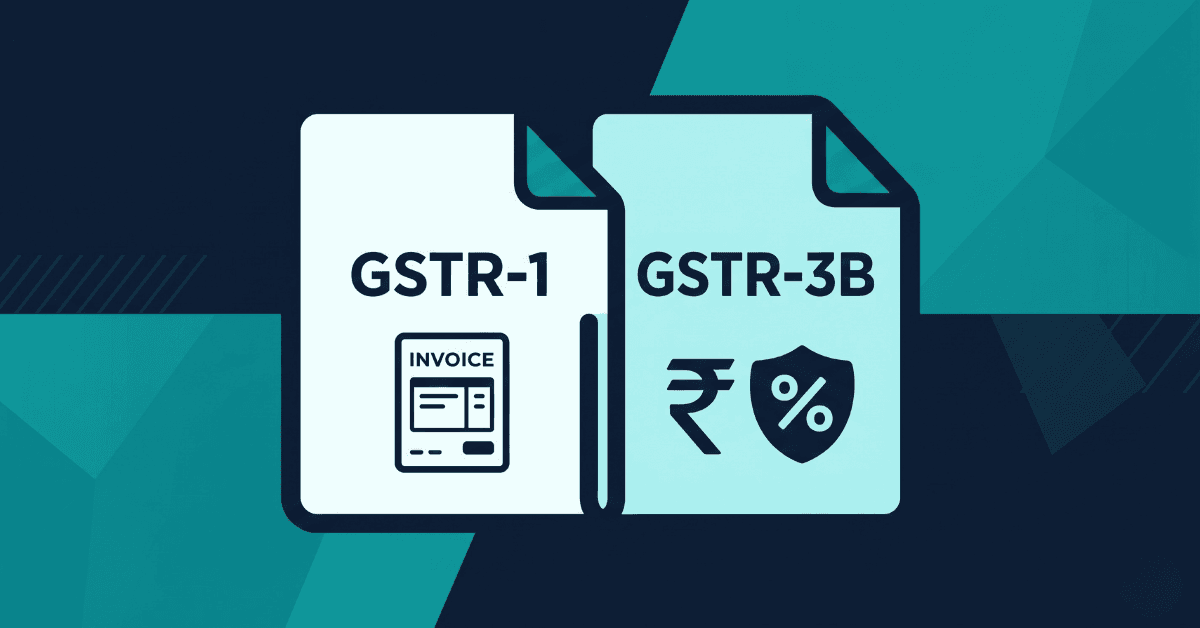
The catch is the conditions. The LUT is valid only for the financial year you file it in, the money for services has to arrive in foreign exchange within a fixed window, and the invoice has to be reported correctly in GSTR-1 and GSTR-3B. Miss any of these and the "zero-rated" invoice can turn into IGST plus 18% interest.
This guide is for freelancers, IT studios, agencies and consultants who export services. Goods exporters use the same LUT, plus shipping bills and port codes.
What does exporting under LUT actually mean?
Exports are zero-rated under Section 16 of the IGST Act. You get two ways to handle the tax. You can pay IGST on the export invoice and claim that IGST back as a refund. Or you can file an LUT in Form GST RFD-11, export without paying IGST, and claim a refund of the unused input tax credit instead.
For most service exporters the LUT route is better, because paying 18% upfront and waiting for a refund locks up working capital for months.
The LUT itself is a promise to the department. You undertake that if the conditions of Rule 96A are not met, you will pay the tax with interest. Circular 8/8/2017-GST allows every registered person to use an LUT, except those prosecuted for tax evasion above Rs 2.5 crore, who must furnish a bond instead. The same circular says the LUT is valid for the whole financial year in which it is filed, and that it is deemed accepted if the officer does not act within three working days.
Does your supply count as an export of services?
Before any of this applies, the supply has to be an export in the first place. Section 2(6) of the IGST Act sets five conditions, and all of them must hold:
The supplier is located in India.
The recipient is located outside India.
The place of supply is outside India.
Payment is received in convertible foreign exchange, or in Indian rupees where the RBI permits it.
The supplier and recipient are not merely establishments of the same person (an Indian branch billing its own foreign head office, for instance).
Two points come up often. First, for services to Nepal and Bhutan, the LUT circular treats them as exports only when payment comes in convertible foreign exchange, so rupee receipts from those countries do not qualify. Second, intermediary services (agents and brokers arranging supplies for a foreign principal) used to have their place of supply fixed in India under Section 13(8)(b), which kept them out of exports. Section 157 of the Finance Act, 2026 omitted that clause with effect from 30 March 2026, so the general recipient-location rule now applies. Invoices from that date can qualify as exports if the five conditions are met. Earlier invoices stay under the old position.
How do you file an LUT on the GST portal?
Filing is free and quick. Do it before the first export invoice of the year. The path on the portal, as set out in the GSTN user guide for RFD-11, is:
Log in at gst.gov.in and go to Services, then User Services, then Furnish Letter of Undertaking (LUT).
Select the financial year in "LUT Applied for Financial Year". For April 2026 to March 2027, that is 2026-27.
Upload last year's LUT if you had one (PDF or JPEG, up to 2 MB).
Tick the declarations and enter the names and addresses of two independent witnesses.
Choose the authorised signatory, enter the place of filing, and sign with DSC or EVC.
Download the acknowledgement. Keep the ARN, because you will quote it on your invoices.
Set a reminder for the first week of April every year. If you discover in July that you never filed for the year, file at once and have your CA review the invoices already raised. Do not assume they will be treated as zero-rated.
What must an export invoice under LUT contain?
An export invoice is a normal tax invoice under Rule 46 with a few changes. In place of the Indian recipient details, the proviso to Rule 46 asks for the recipient's name and address, the delivery address and the name of the country of destination. It also requires one of two endorsements. For LUT exports the wording is: "SUPPLY MEANT FOR EXPORT/SUPPLY TO SEZ UNIT OR SEZ DEVELOPER FOR AUTHORISED OPERATIONS UNDER BOND OR LETTER OF UNDERTAKING WITHOUT PAYMENT OF INTEGRATED TAX".
Field | What to write | Source |
|---|---|---|
Your name, address, GSTIN | As on your registration certificate | Rule 46(a) |
Invoice number and date | Your normal series, up to 16 characters, unique in the year | Rule 46(b), (c) |
Client details | Client name, full foreign address, delivery address, country | Rule 46 proviso |
SAC and description | The SAC for the service and a clear description of the work | Rule 46(g), (h) |
Value | Foreign currency amount and its rupee value at the exchange rate used | Rule 46(j), (k) read with Rule 34 |
Tax | IGST rate and amount shown as nil, with the LUT endorsement | Rule 46(l), (m) and proviso |
Place of supply | The client's country | Rule 46(n) |
LUT ARN and year | For example, "LUT ARN AD240426000000X, FY 2026-27" | Good practice, not a Rule 46 field |
Signature, and IRN/QR if applicable | Physical or digital signature; IRN and QR code if you are covered by e-invoicing | Rule 46(q), (r) |
For the rupee value, Rule 34 says that for services the exchange rate is the one determined under generally accepted accounting principles at the time of supply. In practice, pick one consistent source, such as your bank's rate or the RBI reference rate on the invoice date, and use it every time.
If your aggregate turnover crosses the e-invoicing limit, export invoices need an IRN too, using the export-without-payment supply type.
A worked example: one month's invoice for a US client
Say you run a four-person software studio in Surat. You built a booking module for a client in Austin, Texas, and on 31 October 2026 you invoice USD 6,000. Figures are illustrative.
Exchange rate used on the invoice date (illustrative): Rs 84.20 per USD.
Taxable value: 6,000 × 84.20 = Rs 5,05,200.
IGST charged under LUT: nil. Had you exported on payment of tax, IGST at 18% would have been Rs 90,936 (5,05,200 × 18%), paid in cash and claimed back later.
The client pays on 20 December 2026. Your bank credits USD 6,000 at Rs 84.55, which is Rs 5,07,300. The extra Rs 2,100 is a foreign exchange gain. It goes to your profit and loss account as other income. It does not change the GST value of the invoice, and no debit note is needed. A fall in the rate would be a forex loss, again with no GST effect.
Keep the bank's inward remittance advice (FIRC) against the invoice number. It proves condition four of Section 2(6) and supports any refund claim.
What if the client pays late, or not at all?
Rule 96A gives you a deadline. For services, if payment is not received within one year of the invoice date (or a longer period allowed under FEMA or extended by the RBI), you must pay the IGST, with interest under section 50(1), within 15 days after that period ends. Interest under section 50(1) is 18% a year.
In the example, the clock on the 31 October 2026 invoice runs to 31 October 2027. If the Austin client had still not paid by then, you would owe Rs 90,936 plus interest, and if you did not pay it, the LUT facility could be withdrawn until you did. For goods, the equivalent window is three months from the invoice date for the goods to actually leave India.
A client who drifts from 60 days to 300 days is not only a collection problem. It is a tax problem with a date on it.
How do you report LUT exports in GSTR-1 and GSTR-3B?
In GSTR-1, report the invoice in Table 6A (Exports) and choose the "without payment of tax" type (WOPAY). Enter the rupee taxable value and leave the port code and shipping bill fields blank for services. In GSTR-3B, the same value goes into Table 3.1(b), outward taxable supplies (zero rated). The two figures should match every month.
Do not show export invoices as exempt or nil-rated. Exempt supplies do not get an ITC refund. Zero-rated supplies do.
Claiming back the GST you paid on inputs
Because your export invoices carry no tax, the GST you pay on laptops, software subscriptions, coworking rent and professional fees tends to pile up in the electronic credit ledger. You can claim a refund of that unused credit in Form GST RFD-01. Section 54(1) allows two years from the relevant date, and for exported services the relevant date is the date the foreign exchange is received, or the invoice date if you were paid in advance.
Rule 89(4) works out the refund with a ratio. Suppose that for the October to December 2026 quarter your studio has zero-rated turnover of Rs 15,00,000, domestic turnover of Rs 5,00,000, and net ITC on inputs and input services of Rs 60,000 (capital goods are left out of this figure).
Adjusted total turnover: 15,00,000 + 5,00,000 = Rs 20,00,000.
Refund: 60,000 × 15,00,000 ÷ 20,00,000 = Rs 45,000.
For services, the rule links zero-rated turnover to payments actually realised in the period, so build the working from your FIRCs and bank credits, not only from the invoices raised.
Where hisabkitab fits in
Export billing is repetitive: the same endorsement, address block and currency conversion every month. With hisabkitab's custom invoicing you can set up an export layout with your branding, SAC codes and the LUT endorsement, then use recurring invoices for retainer clients. If you are above the e-invoicing limit, the e-invoicing module generates IRNs and QR codes, in bulk if needed.
On the compliance side, GSTR-1 and GSTR-3B are filed from the same books, the outstanding and ageing report shows which foreign invoices are getting close to the one-year mark, and WhatsApp or email reminders go to clients who are slow to pay. See how this fits studios on the accounting software for IT firms page, or browse the invoicing software features.
Frequently asked questions
Do I need to file a new LUT every financial year?
Yes. An LUT is valid for the financial year in which it is filed, so you file a fresh RFD-11 for each year, ideally in early April before the first export invoice.
Can I receive payment for an export of services in Indian rupees?
Only where the RBI permits rupee settlement for that transaction. Ordinary rupee payments from a client's Indian entity or an Indian bank account usually do not satisfy Section 2(6), so check with your bank before agreeing to it.
What happens if my foreign client does not pay within one year?
Under Rule 96A you must pay the IGST on that invoice, with 18% interest, within 15 days after the one-year period ends. If you do not, the LUT facility can be withdrawn until the amount is paid.
Is an e-invoice required for export invoices?
Yes, if your aggregate turnover is above the e-invoicing threshold. Exports are generated with the export-without-payment supply type and the foreign currency and country details.
Do service exporters need a shipping bill or port code?
No. Those fields apply to goods. For services, leave the port code and shipping bill fields blank in GSTR-1 Table 6A and keep the FIRC or bank advice as your export evidence.
Start a free trial to set up your export invoice format, or compare plans to see which one includes e-invoicing.