


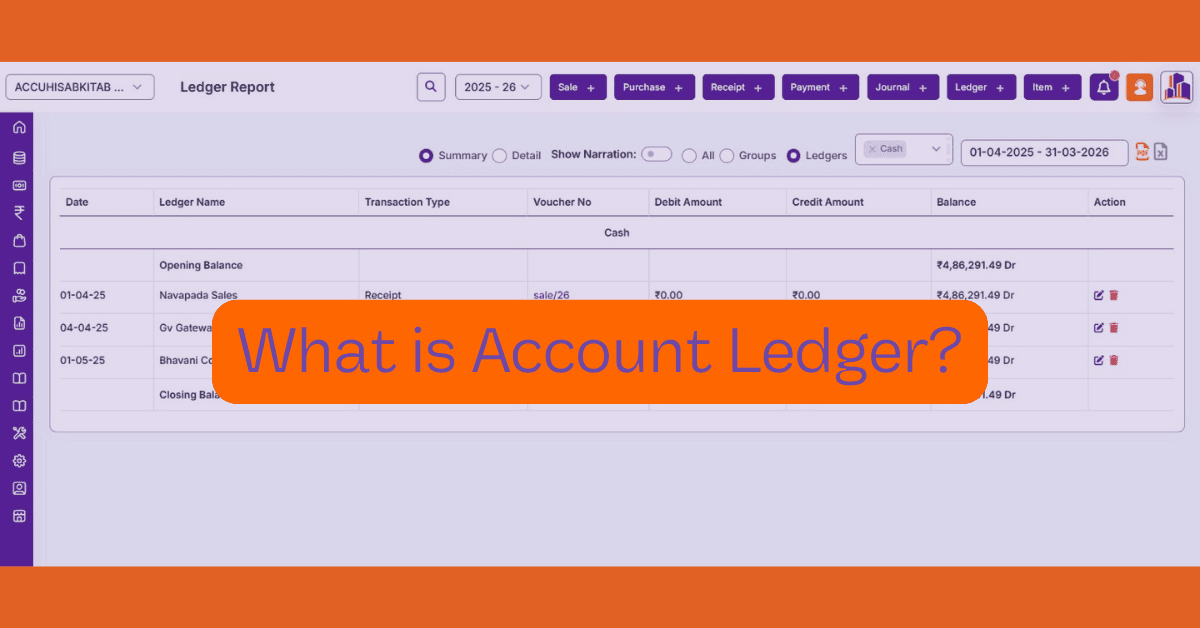

A general ledger holds every account of a business in summary: assets, liabilities, capital, income and expenses. A subsidiary ledger holds the detail behind one of those accounts, such as each customer’s balance behind Sundry Debtors. The total of a subsidiary ledger must always equal its control account in the general ledger.
What is a general ledger?
The general ledger (GL) is the main book of accounts. Every journal entry is posted to it, and the trial balance, profit and loss account and balance sheet are prepared from it. Typical GL accounts are Cash, Bank, Sales, Purchases, Rent, Capital, Sundry Debtors and Sundry Creditors.
What is a subsidiary ledger?
A subsidiary ledger (sub-ledger) records the detail of one GL account that covers many parties or items. The common ones are:
Debtors ledger (sales or accounts receivable ledger): one account for each customer
Creditors ledger (purchase or accounts payable ledger): one account for each supplier
Stock ledger: one account for each item
Fixed asset register: one record for each asset
How control accounts link the two
The GL keeps one control account, for example Sundry Debtors, that shows the total. The debtors ledger shows how that total is split across customers. If Sundry Debtors shows Rs 1,50,000, the customer accounts might be A Traders Rs 80,000, B Stores Rs 45,000 and C Mart Rs 25,000. If the sub-ledger total and the control account do not match, a posting has been missed or entered twice.
General ledger vs subsidiary ledger: key differences
Point | General ledger | Subsidiary ledger |
Scope | All accounts of the business | Detail of one account |
Level | Summary totals | Individual customers, suppliers or items |
Used for | Trial balance and final accounts | Collections, payments, stock and party statements |
How many | One for the business | Several, one for each control account |
Example | Sundry Debtors Rs 1,50,000 | A Traders Rs 80,000, B Stores Rs 45,000, C Mart Rs 25,000 |
Why keep subsidiary ledgers?
The GL stays short and readable
You can see exactly who owes you and whom you owe
Errors are easier to find by matching the sub-ledger with its control account
Different staff can handle sales, purchase and stock records
How accounting software handles it
In accounting software, each customer or supplier is a party ledger placed under a group such as Sundry Debtors or Sundry Creditors. Every invoice posts to the party ledger and the group total at the same time, so the two always agree. In hisabkitab, ledgers, party outstandings and the trial balance update as you bill. See our accounting software page, or read what is an account ledger, sundry creditors and debtors and the golden rules of accounting.
Frequently asked questions
Is the general ledger the same as the trial balance?
No. The general ledger holds all accounts and their entries. The trial balance lists the closing balance of each ledger account to check that total debits equal total credits.
What is a control account?
It is the single account in the general ledger that shows the total of a subsidiary ledger, for example Sundry Debtors for all customer accounts.
Is the cash book a subsidiary ledger?
The cash book is a book of original entry that also works as the cash account, so it is usually treated as part of the ledger itself rather than as a subsidiary ledger.
Does a small business need subsidiary ledgers?
If you sell or buy on credit, yes. Without a customer ledger you cannot tell who owes what, even when the Sundry Debtors total is right.
Find the right HSN or SAC code and GST rate
Browse all 1,289 HSN and SAC headings by chapter, check the GST rate, and bill with the correct code.
