Industry playbook
Interior designers & fit-out studios
How interior designers automate project billing, vendor costs and GST with hisabkitab
Imagine an interior design studio of six to eight people handling residential homes and small office fit-outs. Some clients pay only for design, others hand over turnkey execution, and the studio buys laminates, hardware, lighting and furniture while managing carpenters, painters and electricians on site. Most projects run three to four months, with several overlapping at any time.
See hisabkitab for Interior designers & fit-out studios →
The challenges
Why design studios struggle to see project profit
Design fee or turnkey, often both
One client pays a design fee, another wants turnkey execution, and a third starts with design and later hands over execution. Each needs different invoices and tax treatment, and mixing them on improvised bills confuses clients and the GST return.
Material bought for many sites at once
Laminates, hardware and lighting are bought in bulk and split across projects. Without tagging, the studio cannot tell what each project consumed, and margin on material quietly disappears.
Vendors and contractors to pay and track
Carpenters, painters, electricians and fabricators work on several sites and raise bills irregularly. Payments need TDS where applicable, and contractors' advances must be adjusted against final bills.
Staged client payments
Clients pay a booking amount, then milestones as work progresses. When milestones are tracked in a chat thread, a pending payment is noticed only when cash runs short.
Dimension-based pricing
Wardrobes, kitchens and panelling are priced by area or running feet. Calculating them by hand on quotations causes errors that become arguments at handover.
A day in the life
A day before vs after hisabkitab
Before
Quotations are built in Excel and re-typed into an invoice later.
Material bills are booked to general purchase without any project tag.
Contractor advances are tracked on WhatsApp.
Milestone payments are chased when the studio's bank balance dips.
With hisabkitab
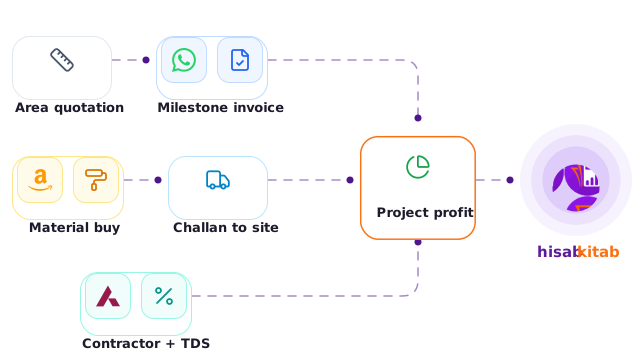
Quotations use area formulas and convert directly into milestone invoices.
Every purchase, challan and contractor bill is tagged to a project.
Contractor ledgers show advances, bills and TDS deducted.
Customer outstanding by project drives polite automatic reminders.
Solutions
How hisabkitab solves it
Mixed design and execution billing
Separate service and goods items + Estimate/Quote
Set up design fee, execution and material lines with their own SAC or HSN and rate. Quotations convert into invoices with the right tax on each line.
Material per project
Custom Field (Transaction level) for Project + Delivery Challan
Tag purchases and challans with the project. Material sent to each site is recorded, and Bill-wise Profit shows margin per project.
Area-based pricing
Custom Field (Item Level) + Formula
Store width, height and units; Area = Width × Height × Units prices wardrobes, shutters and panelling without calculator errors.
Contractor payments
TDS at voucher level + Supplier Ageing
Pay contractors with TDS applied where required and see what each still has to bill against advances.
Milestone collections
Customer Outstanding + Auto-payment reminder
Raise milestone invoices and let automatic reminders follow up, keeping client relationships comfortable.
On-site work
Mobile app
Capture site purchases and share invoices from your phone during site visits.
Client and vendor details
Auto-fill from GSTIN
Type a client's or vendor's GSTIN and hisabkitab fills legal name, address and state, applying CGST + SGST or IGST correctly on every bill.
Inside the software
Built for your books
Custom formula example
Area (sqft) = Width (ft) × Height (ft) × Units. Example: wardrobe shutters 8 ft × 7 ft × 2 units = 112 sqft × ₹1,650/sqft = ₹1,84,800 before GST.
4-level grouping
Items/services: Execution → Carpentry → Wardrobes → Laminate finish. Customers: Segment (Residential / Office) → City → Project lead → Client.
Reports you’ll use
Bill-wise Profit Report · Customer Outstanding Report · Supplier Ageing Report · TDS Report · Party-wise Purchase Report · GST Report
Compliance notes
Interior design services are generally taxed at 18% GST, while turnkey execution that combines goods and labour in an immovable property can be a works contract; confirm the right treatment for each contract type with your CA. Payments to contractors may require TDS deduction under current income-tax law. Material deliveries to site above ₹50,000 can need an e-way bill. Keep site delivery challans with the project file for audits.
Recommended plan
The plan that fits
Boost
₹4,999/year, exclusive of 18% GST (or ₹9,999 for 3 years)
Item and transaction custom fields for project tagging and area formulas, Bill-wise Profit Report and Auto-WhatsApp on Boost suit a studio handling multiple projects with material. Solo designers billing design fees only can start on Launch. Studios with several companies or heavy purchase volumes can move to Advance later without re-entering anything.
FAQs
Frequently asked questions
Can I bill a design fee and turnkey execution separately?
Yes. Create design fee, execution and material as separate items with their own SAC or HSN codes and GST rates. Use them alone or together on quotations and invoices. The tax applies line by line, and your sales reports show design and execution income separately. Clients see a clear split too.
How do I track material used on each project?
Tag purchases and delivery challans with a project field. Material sent to each site is recorded against that project, and the Bill-wise Profit Report compares what you billed with what you spent, so you see the true margin on every home or office you deliver.
Can quotations calculate area automatically?
Yes. Add width, height and units as item-level custom fields with the formula Area = Width × Height × Units. Wardrobes, kitchen shutters and wall panels are priced per square foot without manual maths, and the same lines carry through when the quotation becomes an invoice.
How do I manage contractor advances?
Give each contractor a ledger. Record advances as payments, and when they submit their bill, the ledger shows the balance after advances and any TDS deducted. Supplier ageing shows who still has to bill and who is due a payment. Disputes become rare.
Can I take milestone payments and track them?
Yes. Raise an invoice at each milestone, or record advances against the client ledger. The Customer Outstanding Report shows what is due by client, and automatic WhatsApp and email reminders follow up, so you can focus on design rather than collections.
See the margin on every project
Book a demo and we will set up a sample project with area-based quotation, material challans, contractor ledgers and milestone invoices. Migration from Excel or Tally is included.